
"The participation of women
in the microfinance sector
has sparked a growing interest
in recent decades,
evidencing significant advances
towards gender equality. However,
some important challenges
still persist, so the
definition of immediate strategies
would further strengthen
the female presence
in the sector".

Current data and persistent challenges
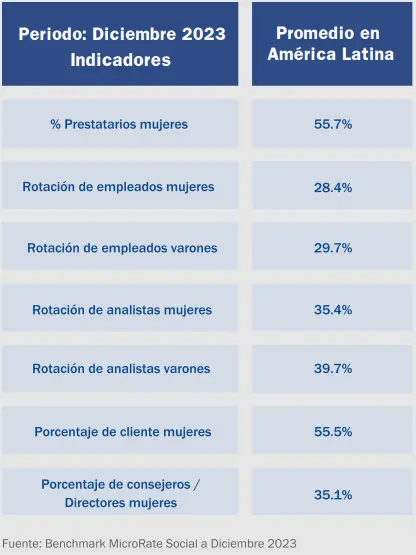
According to the MicroRate Social Benchmark with figures as of December 2023, the percentage of credit attention to women is 55.7% in Latin America. The fact that certain financial institutions serve only women or develop products exclusively for them largely explains this result. This data is interesting considering that women are better payers than men, as indicated in the report on "Financial capabilities of women" issued by the Development Bank of Latin America and the Caribbean (CAF).
Furthermore, the Social Benchmark shows that women have lower turnover compared to their male colleagues. At the employee level, women turnover at 28.4% compared to 29.7% of men; while at the level of credit officers, the turnover of women is higher (35.4%) although still below that of men (39.7%). While these indicators are favorable, they should be considered alongside other factors such as access to job opportunities and career paths within the company, which could explain the lower incentive for women to change jobs.
On the other hand, gender gaps still persist at the executive roles level, where only 35.1% of the Board members are occupied by women, denoting areas for improvement in the leadership positions.

Strategies to promote gender equity
Aware of the gender gaps that still persist in the microfinance sector, it is vital for institutions to identify the social indicators that best measure their performance in terms of equity. Some companies are adopting concrete goals to increase female representation in leadership roles and support women entrepreneurs, as well as improve their access to financing. Therefore, it is appropriate to reflect on the main strategies to be adopted immediately for the promotion of gender equity in this sector.
-
Definition and monitoring of social
objectives:
Microfinance institutions must define and monitor clear objectives oriented towards gender equity. It is essential to have a well-designed strategy and continuously collect data to control and adjust the initiatives towards the established objectives. Addressing existing disparities is crucial to create a more equitable financial environment. - Continuous commitment from the board and staff:
The commitment of the board, management, and employees must be maintained through regular reports and the formation of a specialized committee that addresses issues of equity and inclusion of women. This committee must evaluate the results, the achievement of goals, and the adequacy of the strategies to ensure concrete progress. -
Continuous training and constant feedback:
The ongoing training of internal and external clients is structurally important for obtaining constant feedback and achieving progressive growth in the inclusion of women. This contributes to client retention and the improvement of practices and products of microfinance institutions. -
Suitable financial products:
Developing products that reduce barriers to loan expansion and access to economic opportunities is essential to support women's development. It is important to consider the associated risks and monitor the risk of over-indebtedness. -
Compliance with codes of conduct:
The codes of conduct must promote non-discrimination throughout the credit process. It is important to monitor staff behavior and process claims fairly, protecting the privacy of information and using appropriate technologies.
The participation of women in the microfinance sector is advancing, but still faces challenges. As more policies and programs aimed at gender equity are implemented, it will be essential to continue evaluating, monitoring, and promoting these initiatives.
Finally, with the ongoing commitment of the financial institutions and society in general, it is expected that the gender gap in this sector will continue to decrease in the coming years.

Drafting:
Zulma Chávez
Key account specialist