
For several years, the risk rating agency MicroRate has been producing financial and social benchmarks on a semiannual basis, based on the information of the various Latin American financial institutions we assess. Below, we outline some of the most relevant results for the region, based on figures updated as of December 2023. It is worth noting that this analysis uses medians rather than averages, as they are more reliable in samples with diverse institutions.
According to the analysis, the growth rate of the loan portfolio value remained stable at around 12%, a pace similar to that of the previous year. Slightly more than half of that increase was attributable to the expansion of the borrower base. A higher average loan explains the rest of the variation.
When these results are compared with those of the previous period, the average loan increases by 10.3%, sustaining the momentum of the loan volume. These larger loans may reflect an adaptation to financing needs as a result of inflation. At the same time, they may also mean greater exposure of the financial institution to credit risk, since they may imply a greater concentration of the portfolio in certain products.
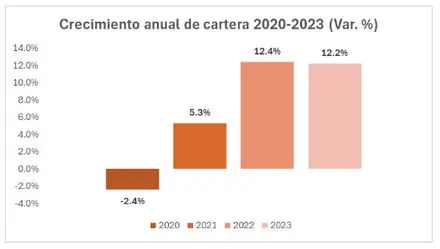
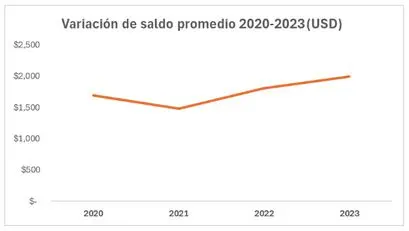
It is worth noting that maintaining the portfolio's growth pace in a context of low growth for the Latin American region is also, in part, a reflection of the strong competition that characterizes the financial sector. Some institutions may be more inclined to increase their risk profile to defend their market share. However, such decisions tend to have consequences in terms of portfolio quality.
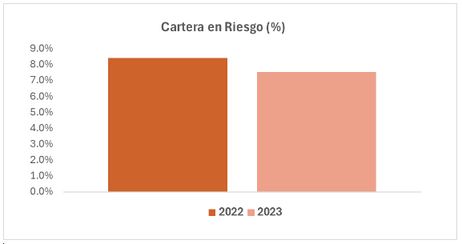
The portfolio-at-risk indicator shows a significant reduction, going from 8.4% to 7.5% within 1 year. In this regard, the median indicates that at least half of the institutions included in the analysis show a significant improvement in the quality of their portfolio. Policies aimed at improving lending after the pandemic, as well as greater caution on the part of institutions, explain these results.
On the operating profitability side, a deterioration is observed compared to the previous year, standing very close to 0%, despite maintaining a stable portfolio yield. The international context of rising interest rates made funding more expensive, with the consequent damage to the financial margin. Added to this was an increase in provisioning expense as a proportion of the portfolio. Financial expense is expected to evolve favorably in the short term—that is, for interest rates to gradually decline—while the outlook for provisioning expense will depend more on each institution's ability to maintain alignment between a prudent credit methodology and disciplined execution in the field.
Writing:
Eduardo Zuñiga
Executive Manager