“The role of women in the microfinance sector goes beyond the creation of businesses. Microfinance has become a key tool for promoting economic inclusion, empowering women and allowing them to improve the living conditions of their families.“

Thanks to access to these services, women not only increase their opportunities to generate income, but they also raise the quality of education, health, and well-being of their households. This generates a positive and multiplier impact in their communities, driving social and economic development. Another important aspect to highlight is the responsibility of women in managing their finances. Various studies show that, in general, women are more compliant in repaying their loans than men, which translates into lower delinquency rates and higher returns for financial institutions. In Latin America, female participation in the microfinance sector has experienced notable growth. In fact, according to the Social Benchmark prepared by MicroRate with figures as of June 2024, it is evident that 60.7% of clients in Peru are women, placing above the 58.2% Latin American average. This same result is evident at the borrower level (credit takers), where 64.1% of borrowers in Peruvian microfinance institutions are women, compared to 59.1% in the region.
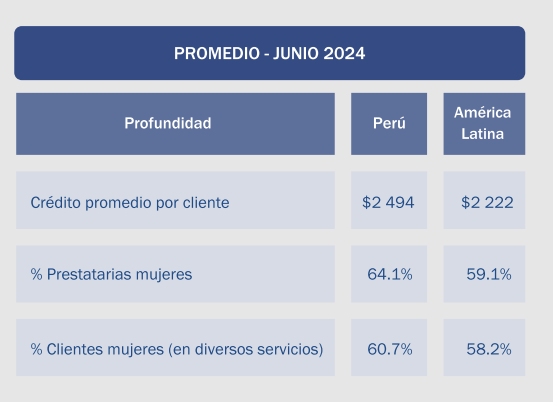
In Latin America, female participation
in the microfinance sector has
experienced notable growth. In
fact, according to the Social Benchmark
prepared by MicroRate with figures as of June
2024, it is evident that 60.7% of the
clients in Peru are women, placing
above the 58.2% of the Latin American
average. This same result is
evident at the level of borrowers (credit
takers), where 64.1% of the
borrowers in Peruvian
microfinance institutions are women,
compared to 59.1% in the region.
This increase is a clear indication of progress in financial inclusion, but it also underscores the need to go beyond the simple offering of financial products. Institutions must provide a complete package of services that not only addresses credit needs but also promotes sustainable business growth through training, workshops, and strengthening business networks.

Best practices to enhance female participation in the microfinance sector
To ensure that access to credit and microfinance services truly contribute to the improvement of the well-being of women, institutions must adopt approaches that not only promote financial inclusion but also their empowerment. Some of the best international practices include:
- Training in soft skills: The development of leadership skills, negotiation, and conflict resolution helps women to be more competitive and self-assured in the business realm, increasing their chances of success.
- Technological training: In an increasingly digitalized world, training in technological tools is essential. Empowering women in the use of digital platforms, social networks, and specialized software allows them to optimize their businesses and reduce operational costs.
- Promotion of savings: Implementing savings programs that allow women to plan for the long term and face possible economic crises provides them with greater financial security, which in turn increases their ability to invest in their businesses and in their families.
- Talks aimed at empowering women: These talks, directed at the whole family, seek to raise awareness about the role of the entrepreneurial woman within the home, based on a foundation of equity with men.
- Support and empowerment networks: Creating meeting and networking spaces among women entrepreneurs fosters the exchange of experiences, knowledge, and business opportunities. These networks not only contribute to the individual growth of businesswomen but also promote the development of support communities.
- Financial products tailored to their needs: Understanding the particular circumstances of women and their specific needs is key to offering financial products and services properly adapted to address their daily challenges and enable them to achieve their short- and long-term goals.
Although challenges still persist, the presence and leadership of women are making a tangible difference in creating a more inclusive, diverse, and sustainable economy. Women are not only building businesses but also new opportunities that transform lives and communities, generating a more inclusive and equitable future for all.

Editing:
Zulma Chávez
Key account specialist